

What is TECHnically different about Harvest?
How Harvest’s technology fits together
Scenario-based assessment
Responses to realistic relationship scenarios.
The Soil
A structured relational-value profile across five core dimensions, preserving how a person shows up and what they value from a partner.
Insights
Compatibility insights, values-map comparisons, and structured context for The Gardener.
Soil data is the structured context The Gardener reasons against ↓
Conversations & questions
Natural-language questions and privately shared screenshots or message exchanges.
Grounded
Eight behavioral dimensions and three evidence levels that structure how interactions are interpreted.
The Gardener
Built on OpenAI models and configured for Harvest; connects what is happening back to the user’s Soil values.
The Soil
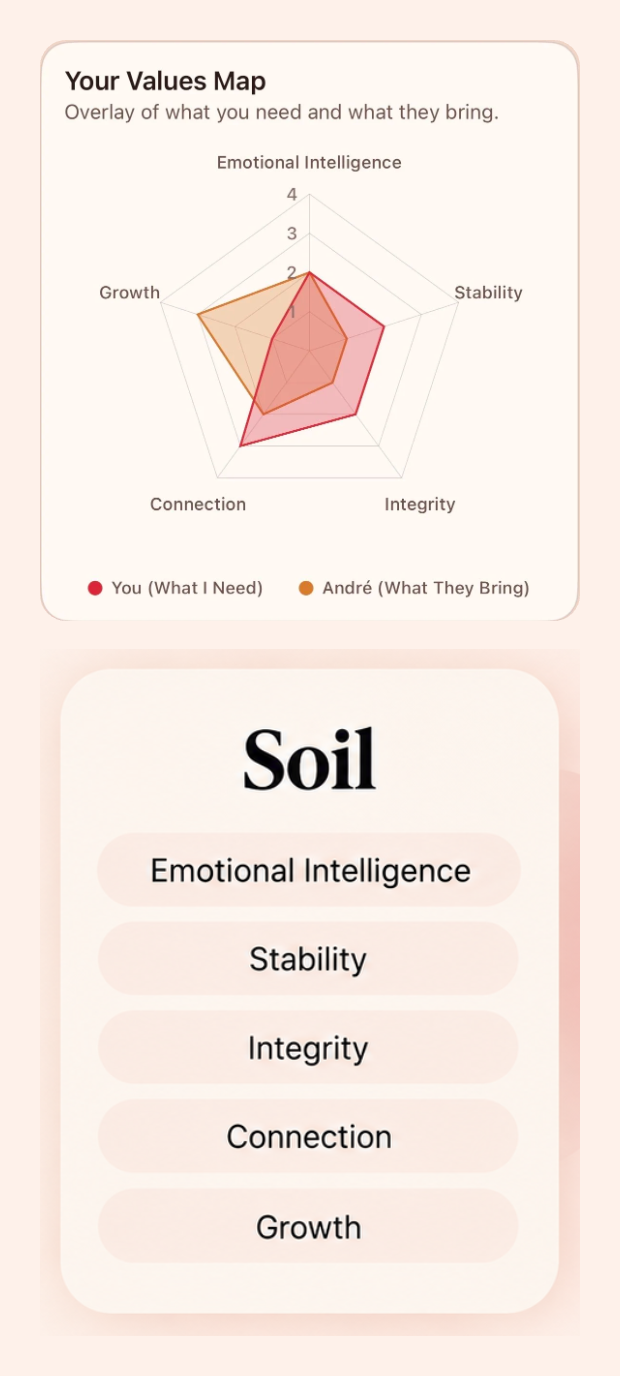
The Soil converts scenario-based assessment responses into structured relational-value profiles that can be used across compatibility insights and AI coaching.
Responses are mapped across Harvest’s five core dimensions — Emotional Intelligence, Stability, Integrity, Connection, and Growth — and converted into structured values data that can be visualized, compared, and used throughout the app.
The Soil preserves the distinction between how a person tends to show up and what they most value from a partner. That creates a multidimensional profile that Harvest can use for compatibility insights, values-map comparisons, and as structured context for The Gardener.
The key tech point is that Soil creates the data layer The Gardener can reason against. So when a user later asks about a conversation or relationship interaction, The Gardener can connect what is happening in that interaction back to the user’s stated relational priorities instead of responding only to the text in front of it.
Grounded
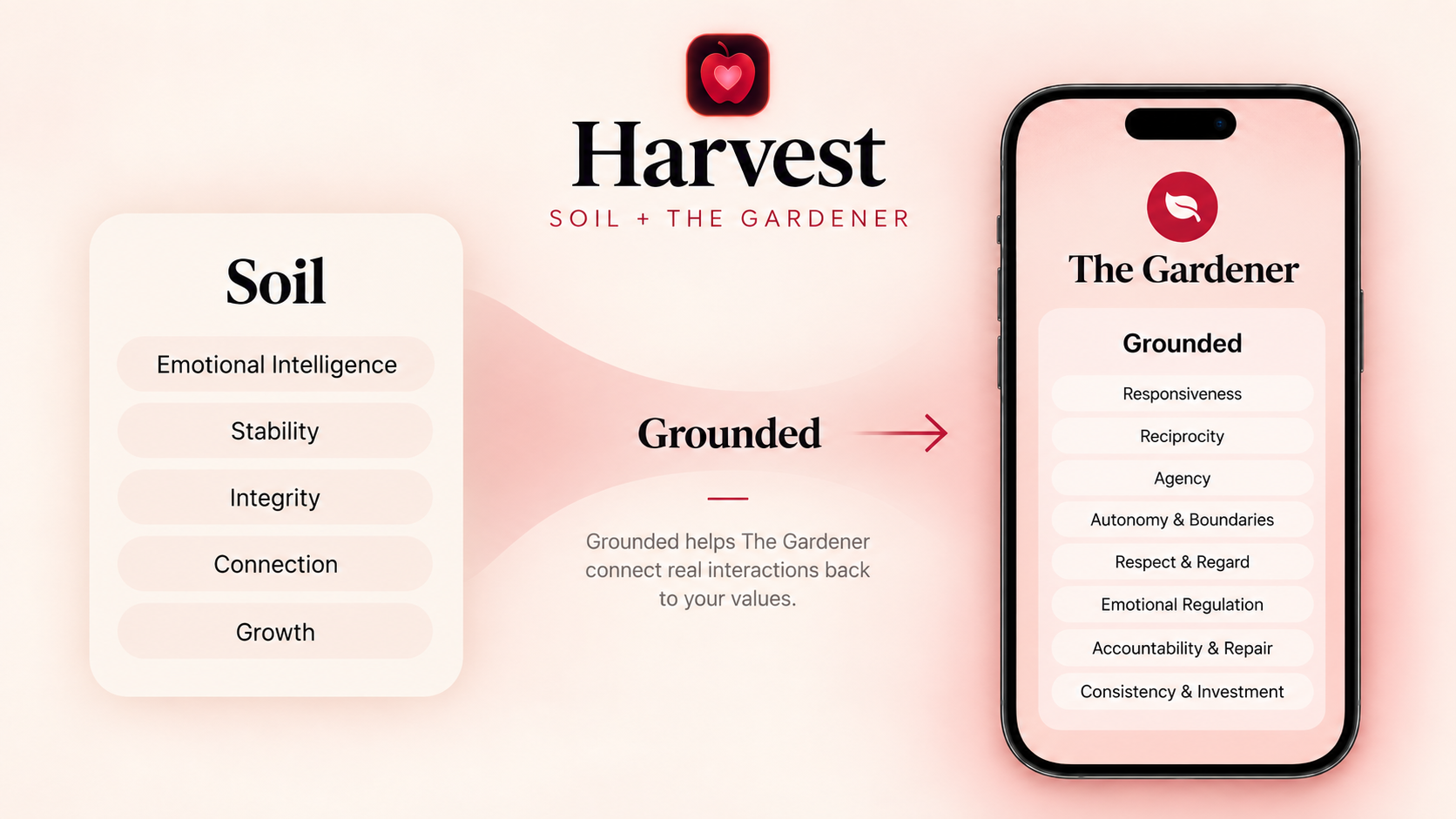
A research-informed behavioral reasoning framework for interpreting relationship interactions.
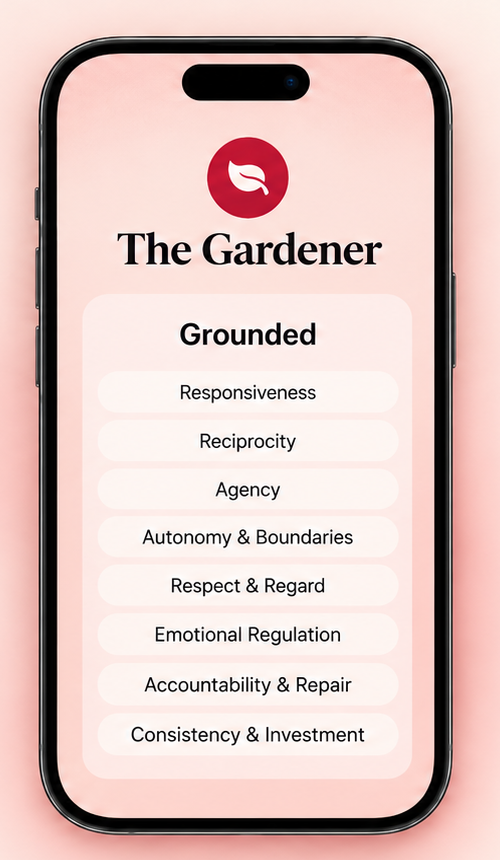
Grounded gives The Gardener a structured way to move from raw conversation data to relational insight. It organizes observable behavior across eight dimensions: Responsiveness, Reciprocity, Agency, Autonomy & Boundaries, Respect & Regard, Emotional Regulation, Accountability & Repair, and Consistency & Investment.
The framework combines values + interaction + context to identify patterns without reducing a conversation to isolated keywords or one-off reactions.
The structured reasoning sequence
Users can privately upload conversations or screenshots for analysis. The Gardener evaluates the interaction through a structured reasoning sequence that starts with what was actually said or done and then considers context, repetition, both people’s contributions, alternative explanations, relevant Grounded dimensions, and alignment with the user’s stated values.
- 1Identify observable behavior before interpreting motive.
- 2Separate direct evidence from inference.
- 3Consider surrounding context and whether a pattern is isolated or repeated.
- 4Evaluate both people when enough of both sides is visible.
- 5Consider reasonable alternative explanations when the evidence is ambiguous.
- 6Connect relevant patterns to Soil values and the user’s I Bring / I Need priorities.
- 7Keep the strength of the conclusion proportional to the evidence.
Each finding is described with one of three evidence levels, giving the system a consistent vocabulary:
In technical terms, Grounded acts as the reasoning framework between the user’s input and The Gardener’s generative response, giving the model a consistent domain-specific structure for relationship analysis.
The Gardener
A domain-specific generative AI reasoning layer for dating and relationships.
The Gardener is built on OpenAI models and configured specifically for Harvest through custom system instructions, structured reasoning rules, research-informed frameworks, and example-based training.
It can interpret natural-language conversations, user questions, and privately shared screenshots or message exchanges, then reason across more than the text itself. Its analysis considers context, repetition, both people’s contributions, alternative explanations, relational patterns, and the user’s structured Soil data.
The Gardener uses Harvest-specific logic to connect what is happening in an interaction back to the user’s stated values, communication patterns, and relationship priorities.
The Gardener generates conversational guidance without scripting exact messages for the user. The result is a generative AI coach that can hold an ongoing conversation while reasoning within a purpose-built dating and relationship framework.
Neutrality and evidence checks
The Gardener’s reasoning layer includes checks intended to reduce unsupported conclusions and one-sided analysis. Training examples include ambiguous situations, benign explanations, cases where the uploader contributed to the problem, cases where both people contributed, role-reversal tests, and multi-turn examples in which repetition changes the strength of the conclusion.
Does the response distinguish what happened from what someone may have intended?
Does it avoid automatically siding with the person who uploaded the conversation?
Does it treat one event differently from a repeated pattern?
Does it consider a reasonable alternative explanation when one exists?
Does it apply the same standard across genders and roles?
Is the strength of the conclusion proportional to the available evidence?